




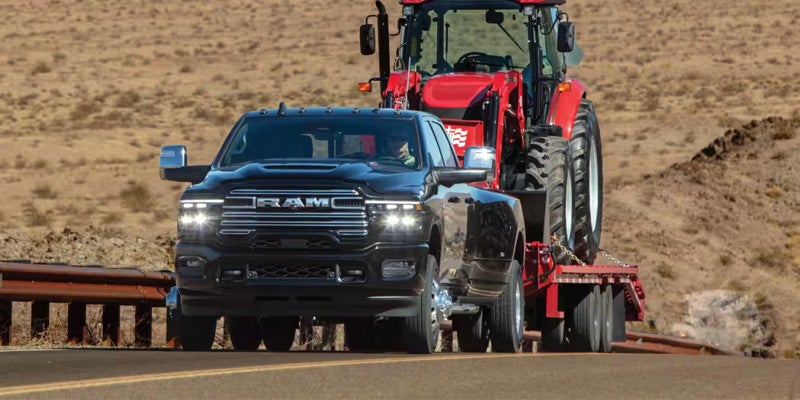
The Ram 2500 and Ram 3500 are both heavy-duty trucks, but that shared description can disguise a substantial difference in capability. The 2500 can tow up to 20,000 lbs. The 3500 stretches that figure to 37,090 lbs. Payload tells a similar story. For truck buyers around Baytown, Texas, the Ram 2500 versus Ram 3500 decision should start with numbers, not trim badges. Figure out what the truck needs to carry and tow, then work backward from there.
The Engines Are Familiar, the Ratings Aren’t
Both trucks offer a standard 6.4L HEMI® V8 paired with a TorqueFlite® 8-speed automatic transmission. The available High-Output 6.7L Cummins® Turbo Diesel I6 uses a TorqueFlite® HD 8-speed automatic. That shared engine availability doesn’t produce identical capability. Properly configured, the gas-powered Ram 2500 can tow up to 17,740 lbs. Move to the High-Output Cummins® and maximum towing reaches 20,000 lbs. The 6.4L HEMI® V8 also allows up to 4,580 lbs. of maximum payload with the available Payload Upgrade Package. Those are serious numbers. A 2500 isn’t simply what you buy when you don’t need a 3500.
The Ram 3500 Is Where Capacity Takes Over
If your trailer or payload requirements regularly push beyond 2500 territory, the Ram 3500 provides a considerable step upward. With the 6.4L HEMI® V8, maximum payload can reach 7,590 lbs. Equip the truck with the High-Output 6.7L Cummins® Turbo Diesel and maximum towing climbs to 37,090 lbs. when properly configured. The 3500 RAM also offers single-rear-wheel and dual-rear-wheel configurations. Rear track width measures 67.1 inches on SRW models and 75.9 inches with DRW. Regular Cab, Crew Cab, and Mega Cab® configurations provide further flexibility. The important part is matching those choices to the job rather than assuming every 3500 carries the maximum rating.
Power Wagon® Gives the 2500 Its Own Specialty
There is one direction where the Ram 2500 gets something its bigger sibling doesn’t: Power Wagon®. The 2500-exclusive Power Wagon® is a Crew Cab 4x4 with a 6-foot 4-inch bed and standard 6.4L HEMI® V8. It comes with Bilstein® off-road shocks, Ram Articulink® front suspension, an electronic disconnecting front sway bar, locking front and rear axles, skid plates, and increased ride height. That makes the 2500 particularly interesting for buyers who need heavy-duty truck capability but also spend meaningful time away from pavement.
Heavy Duty Doesn’t Have to Mean Bare Bones
Capability may determine which truck you need, but it doesn’t dictate how comfortable it has to be. Laramie® models offer a 12-inch digital Driver Information Display, Uconnect® 5 NAV with a 12-inch touchscreen, heated leather-trimmed front seats, and a 10-speaker premium audio system. Limited moves further with a 14.5-inch Uconnect® 5 NAV touchscreen, 10.25-inch front-passenger interactive display, dual wireless charging pads, and premium leather seating. So, you can configure either truck around long hours in the cab without giving up the heavy-duty hardware underneath it.
Start With the Trailer, Then Choose the Truck
If your towing needs remain within the Ram 2500’s 20,000-lb maximum and its payload ratings suit the job, there may be little reason to move into a 3500. Power Wagon® also gives off-road-focused buyers a capability package unique to the 2500. The Ram 3500 earns its place when heavier payloads and trailers dictate the purchase. Its available DRW configuration, 7,590 lb. maximum payload, and 37,090 lb. maximum towing capacity put it in another class of work.
Drivers around Baytown can compare new Ram Heavy Duty inventory at Wischnewsky Dodge Jeep Ram of Baytown, review cab, bed, engine, and rear-wheel configurations, and match the truck to the load. Once you’ve narrowed down the choices, schedule your Ram 2500 or Ram 3500 test drive online and see which one fits the job.